Customer Success
How Southern Radiology Ventures Doubled Exam Volume in Less than 1 Year
See how Southern Radiology Ventures scaled from 10 to 20 sites and doubled exam volume in under a year, without doubling back-office headcount, using New Lantern.
/
AUTHOR
Pragati Dwivedi

Southern Radiology Ventures (SRV), a growing, physician-led radiology organization delivering comprehensive diagnostic imaging services across outpatient centers, hospitals, and partner facilities. Its network includes The Radiology Clinic, a practice competing in one of the most crowded radiology markets in the Southeast USA.
The Organization & The Target
Southern Radiology Ventures set out to do what every ambitious radiology organization wants and few pull off cleanly: grow fast, adding outpatient sites, hospital coverage relationships, and affiliated radiology groups, without growing the overhead required to run the back office. That meant adding sites and reading volume at a pace most groups' scheduling and coordination cannot absorb, all while still matching every case to the right reader, every time.
A radiologist at The Radiology Clinic, one of the practices within SRV's network, describes what that growth has felt like day to day:
"Since starting New Lantern, I think my output has increased significantly, probably about 30 to 40 percent. I'm spending less time doing the dictation part and actually spending more time looking at the study. I feel like I'm doing a better job looking at the study. Efficiency has always been a priority for me, and I think that's what really hit home with the product."
Dr. Hugh Borack, The Radiology Clinic
The Roadblock
SRV already had a reading pool that worked: staff radiologists, per-diem coverage, subspecialists, and locums, scheduled through QGenda. That setup was not broken; it is what let SRV grow in the first place. But every new site meant fitting another roster into the same shared workload fairly, without dropping coverage or subspecialty match. This coordination problem grows harder with every added site, and it is the kind of problem that quietly caps growth long before demand does, leaving someone to do by hand what should scale on its own.
The Solution
Rather than asking SRV to change how it staffed or scheduled, New Lantern built a worklist that plugs directly into the QGenda and other systems, SRV already used. It pulls the live on-shift schedule automatically, matches every incoming exam to an eligible reader in real time, and load-balances the workload evenly across every site. Flex and non-urgent work is queued and ready before a radiologist logs on, STAT and SLA cases are prioritized automatically, and cases nearing their deadline are re-routed on their own, with admins retaining the ability to override any case by hand.
New Lantern's team stood up SRV's first roughly seven hospital sites hand-in-hand, then handed SRV the tools and integration playbook to lead new-site pickup on their own timeline, with New Lantern supporting rather than sitting in the critical path.
From there, SRV's growth followed its own momentum. Sites roughly doubled, growing from about 10 to about 20, and annual exam volume followed a similar trajectory, climbing from roughly 500,000 to approximately 1,000,000 studies. To support that volume, SRV brought on additional radiologists, growing its reading capacity in step with demand. What did not grow at the same pace was the back office required to run it: administrative headcount moved from about 20 to roughly 25, a fraction of the increase seen in sites and exam volume. That gap is the clearest measure of what the platform was built to do: absorb the coordination work that would otherwise scale headcount alongside every new site and every new hire.
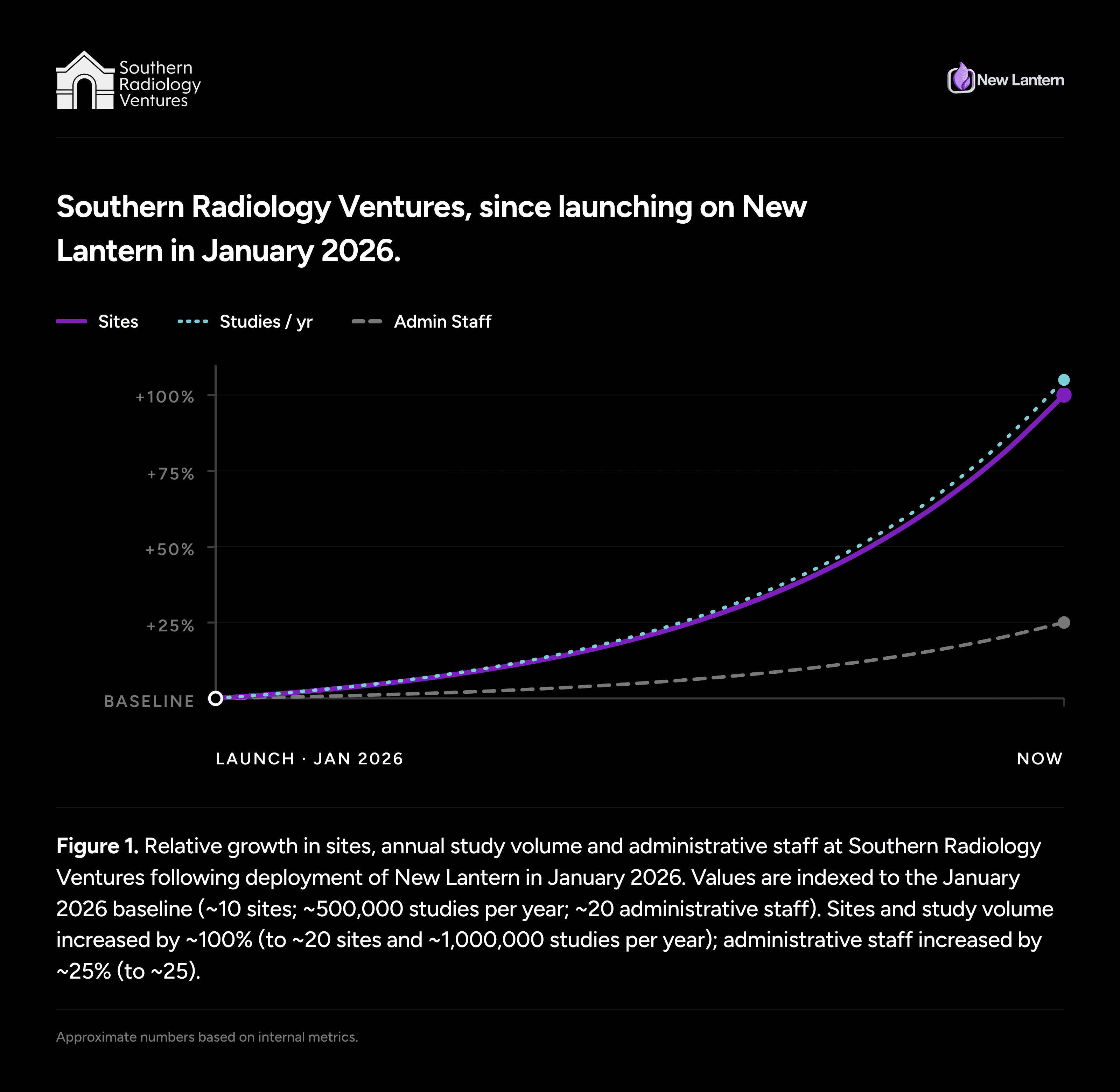
The system scaled from ten sites to twenty without requiring a manual rebuild at each step, all on the same New Lantern platform.
If you are looking to double, or even triple, your read volume with a robust system that scales alongside the staffing structure you already have, instead of asking you to rebuild it first, let's talk about what that looks like for your practice.
Southern Radiology Ventures (SRV), a growing, physician-led radiology organization delivering comprehensive diagnostic imaging services across outpatient centers, hospitals, and partner facilities. Its network includes The Radiology Clinic, a practice competing in one of the most crowded radiology markets in the Southeast USA.
The Organization & The Target
Southern Radiology Ventures set out to do what every ambitious radiology organization wants and few pull off cleanly: grow fast, adding outpatient sites, hospital coverage relationships, and affiliated radiology groups, without growing the overhead required to run the back office. That meant adding sites and reading volume at a pace most groups' scheduling and coordination cannot absorb, all while still matching every case to the right reader, every time.
A radiologist at The Radiology Clinic, one of the practices within SRV's network, describes what that growth has felt like day to day:
"Since starting New Lantern, I think my output has increased significantly, probably about 30 to 40 percent. I'm spending less time doing the dictation part and actually spending more time looking at the study. I feel like I'm doing a better job looking at the study. Efficiency has always been a priority for me, and I think that's what really hit home with the product."
Dr. Hugh Borack, The Radiology Clinic
The Roadblock
SRV already had a reading pool that worked: staff radiologists, per-diem coverage, subspecialists, and locums, scheduled through QGenda. That setup was not broken; it is what let SRV grow in the first place. But every new site meant fitting another roster into the same shared workload fairly, without dropping coverage or subspecialty match. This coordination problem grows harder with every added site, and it is the kind of problem that quietly caps growth long before demand does, leaving someone to do by hand what should scale on its own.
The Solution
Rather than asking SRV to change how it staffed or scheduled, New Lantern built a worklist that plugs directly into the QGenda and other systems, SRV already used. It pulls the live on-shift schedule automatically, matches every incoming exam to an eligible reader in real time, and load-balances the workload evenly across every site. Flex and non-urgent work is queued and ready before a radiologist logs on, STAT and SLA cases are prioritized automatically, and cases nearing their deadline are re-routed on their own, with admins retaining the ability to override any case by hand.
New Lantern's team stood up SRV's first roughly seven hospital sites hand-in-hand, then handed SRV the tools and integration playbook to lead new-site pickup on their own timeline, with New Lantern supporting rather than sitting in the critical path.
From there, SRV's growth followed its own momentum. Sites roughly doubled, growing from about 10 to about 20, and annual exam volume followed a similar trajectory, climbing from roughly 500,000 to approximately 1,000,000 studies. To support that volume, SRV brought on additional radiologists, growing its reading capacity in step with demand. What did not grow at the same pace was the back office required to run it: administrative headcount moved from about 20 to roughly 25, a fraction of the increase seen in sites and exam volume. That gap is the clearest measure of what the platform was built to do: absorb the coordination work that would otherwise scale headcount alongside every new site and every new hire.
The system scaled from ten sites to twenty without requiring a manual rebuild at each step, all on the same New Lantern platform.
If you are looking to double, or even triple, your read volume with a robust system that scales alongside the staffing structure you already have, instead of asking you to rebuild it first, let's talk about what that looks like for your practice.
/
BLOG
Other insights
Product Enhancements
/
Mar 10, 2026
New Lantern Releases State-of-the-art Radiology Speech Model
New Lantern's speech model is purpose-built for radiology dictation, handling medical terms, laterality, and dates that general speech engines get wrong.
Product Enhancements
/
Aug 5, 2025
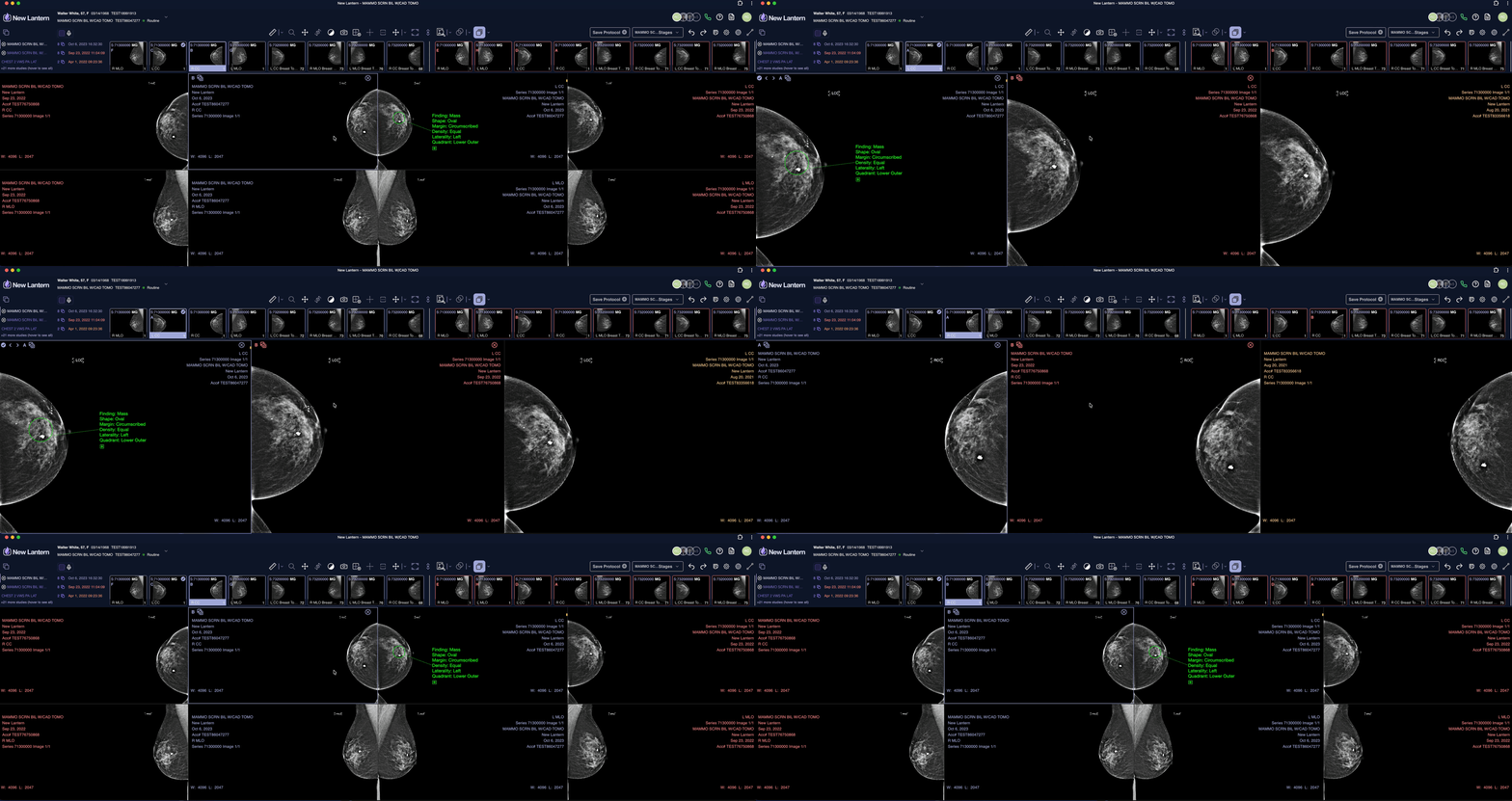
New Lantern Releases Advanced Mammography & PET/CT Viewer Modes
New Lantern, the first AI-native complete radiology solution, today announced the launch of two specialized viewer modes: the Mammography Viewer Mode and PET/CT Viewer Mode. These solutions address bottlenecks in breast imaging and breast and PET/CT imaging, delivering the company's signature sub-second load times and AI-powered automation, called Curie, to all imaging modalities. With these additions, the company now serves the full spectrum of imaging modalities, delivering the only complete AI radiology solution that eliminates the need for radiologists to navigate multiple platforms.
Insights
/
Jun 15, 2025
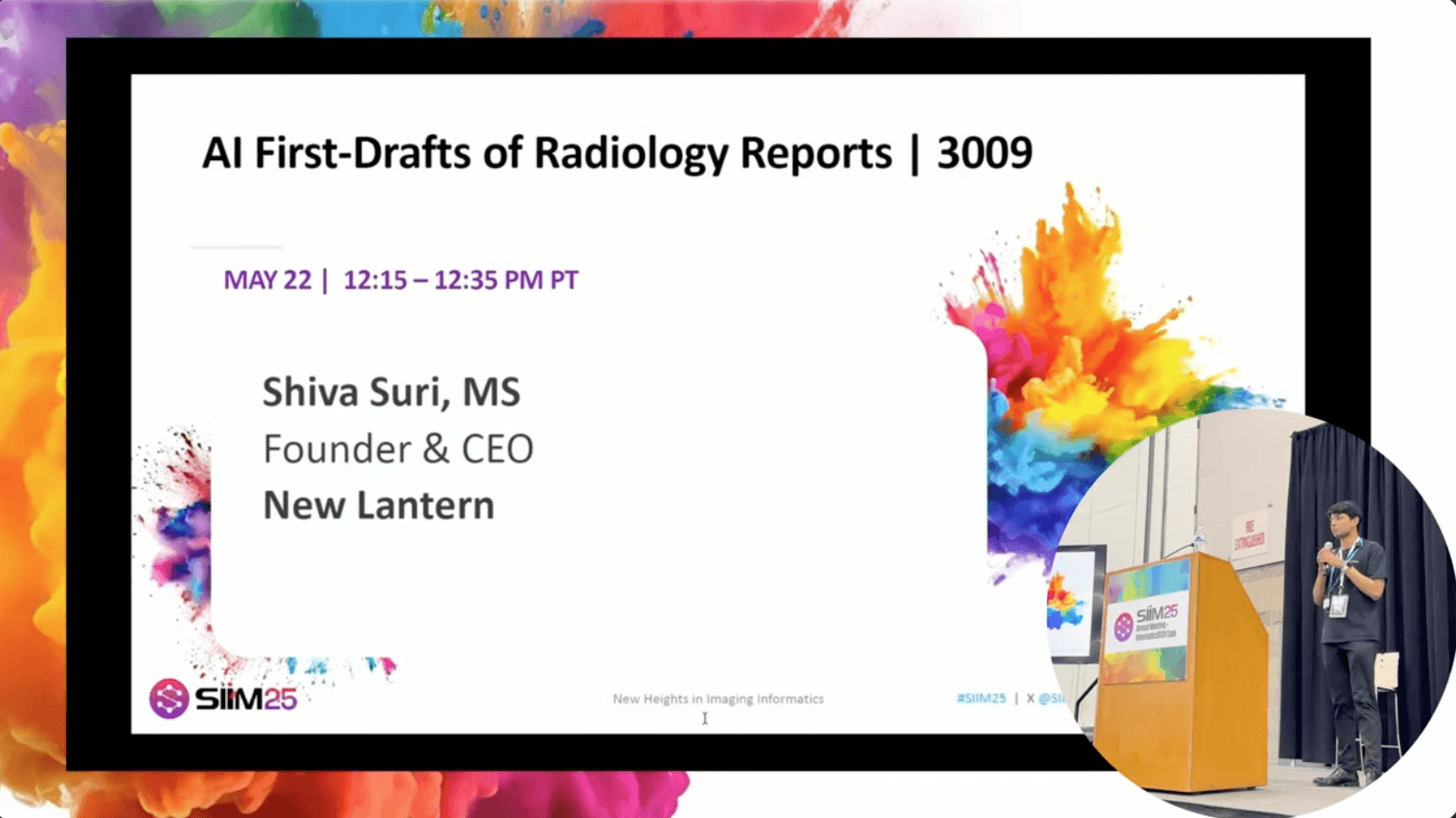
AI First Drafts of Radiology Reports: From 205 Dictated Words to 57
New Lantern CEO Shiva Suri explains how AI first drafts cut a 205-word radiology dictation to 57 words using OCR, viewer signals, and generative AI.